 ChanTape
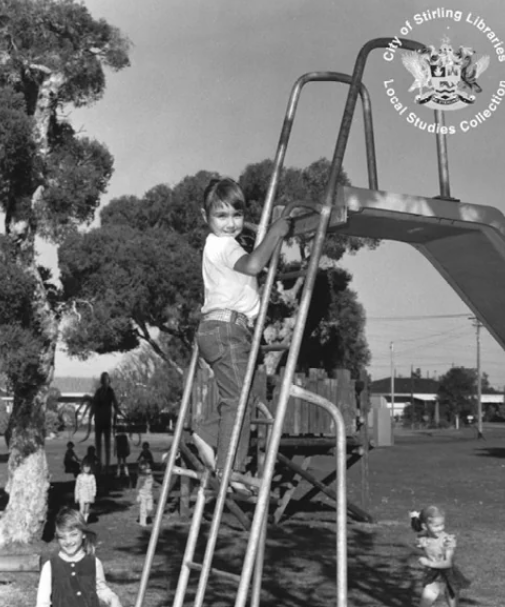
The figure was behind the children. That was the important part.
A tall shape in a dark suit occupied the background of an apparently ordinary photograph. The accompanying story gave the image an ominous history. But the actual origin was considerably easier to establish than the invented one: a Something Awful forum thread, June 2009, and a participant calling himself Victor Surge. 2
Slender Man did not require a lost manuscript or an anonymous confession. His creation happened in public. The resulting mythology spread anyway, carried by people who could know exactly where the monster came from and still enjoy making the next piece of evidence.
A photograph asking to be investigated
The challenge on Something Awful invited users to create paranormal images. Eric Knudsen, posting as Victor Surge, supplied two manipulated photographs and text that suggested a disturbing backstory. The character’s name was attached to those early contributions. 2
The design rewarded a second look. Place an obvious monster in the center and the image becomes an illustration. Put something wrong at the edge of a group photograph and the viewer becomes a participant in discovering it.
The caption then changes the task again. It encourages the reader to treat the picture as an item retrieved from an earlier event. The manufactured document arrives with a manufactured reason to be worried about it.
The creator did not hide the invention
In a preserved interview, Knudsen described the initial work as a spontaneous attempt to make something he personally found frightening. He discussed influences from horror fiction, games, and stories about unfamiliar figures. He also expressed surprise at the character’s movement beyond the original forum. 1
That testimony is useful because it describes an act of composition. It does not support the idea that the artist accidentally photographed a real entity or recovered a forgotten ancient tradition.
The existence of an identifiable creator makes Slender Man an especially revealing internet legend. Belief and participation do not have to coincide. A reader can understand the construction, add another fictional sighting, and help circulate the character without becoming confused about whether it exists.
A backstory that traveled as a file
The early photographs were well suited to movement. An image and a short caption can be copied into another thread with little preparation. A new audience can encounter the unsettling object before encountering the discussion that explains how it was made.
Dazed’s account describes subsequent contributions that presented the character through found-footage formats, altered historical-looking material, and apparent documents. Those additions gave the invention the texture of a scattered archive. 3
The appearance of age was part of the fiction. A purported old woodcut or historical account does not move the character’s documented origin backward in time. The relevant questions are when that specific object was created and how it entered circulation.
This distinction allows the invented archive to remain interesting on its own terms. It is a record of people practicing the language of evidence, not a collection of proof for a supernatural creature.
The woods acquired a camera
Marble Hornets developed a related visual world on YouTube. Its opening video presents a reason for reviewing and uploading old footage, turning the act of going through recordings into the premise of a continuing story. 6
A video series changes how the audience encounters a background figure. The frame moves, sound drops away or becomes difficult, and viewers can disagree about the exact moment something becomes visible. Pausing and replaying become normal reading behavior.
The series’ figure, the Operator, belongs to its own continuity. Treating every story associated with Slender Man as one official narrative erases the choices made by different creators. Similar imagery does not mean identical rules, events, or authorship. 3
The mythology did not have one editor
The Slenderverse community’s historical overview records a wider field of independent projects and characters. Its value lies partly in showing that the phenomenon was an ecosystem of works rather than a single endlessly extended story. 4
A shared silhouette can connect those projects while their individual accounts diverge. One version emphasizes surveillance; another follows a group of friends; another uses puzzles or audience interaction. Readers learn to recognize a family resemblance without requiring a unified explanation.
This is why a compact monster biography can be misleading. It assembles features drawn from different projects and presents them as if somebody issued a definitive instruction manual. The resulting certainty is often an artifact of the summary, not a property of the source material.
Even a monster has image sources
A later PHANTASM.com article reproduces an early forum exchange in which Knudsen discussed using imagery associated with the Tall Man from Phantasm as a base for some of his manipulations. The article also presents fan research proposing a more specific source photograph. 5
These are different levels of evidence. A reproduced statement attributed to the creator bears on his stated process. A proposed match to a particular product image still deserves inspection on its own merits. The stronger claim should not simply inherit the confidence of the weaker one.
The interesting point is how ordinary the underlying activity can be. Selection, compositing, repainting, and a carefully chosen caption can give a new figure the apparent weight of a recovered memory. Knowing the method adds a second subject to the image: the person making it.
The origin is part of the horror
Slender Man’s fictional status is clear. His cultural history remains worth investigating precisely because the origin can be traced. The record lets us watch people create the appearance of a tradition rather than merely speculate about where a tradition began.
The photographic format supplies an invitation to doubt the caption. The forum supplies an invitation to improve it. Later video projects supply time, motion, and a reason to return. None of those steps requires a supernatural event; together they can produce the feeling of a much larger story waiting outside the frame.
The first images should therefore be shown with honest captions. They are manipulated artworks credited to Knudsen, not anonymous historical photographs offered as evidence. Preserving that fact does not flatten their effect. It lets the reader appreciate the precision of the trick.
Look again at the figure behind the children. The monster is an invention. The impulse to zoom in, check the next frame, and show somebody else is the part the archive can actually document.
Timeline
- 2009-06-10 — Victor Surge Slender Man appears in the paranormal-image thread.
- 2009 — Marble Hornets A related video narrative begins on YouTube.
- 2011 — Creator interview preserved Knudsen describes the invention and its spread.
- Later — Many continuities Independent works expand the shared visual language.
What we know
- Established Eric Knudsen created Slender Man in a public image-manipulation thread.
- Fiction The supposed historical sightings and documents are narrative devices.
- Keep separate Marble Hornets and other projects have distinct creators and continuities.