 ChanTape
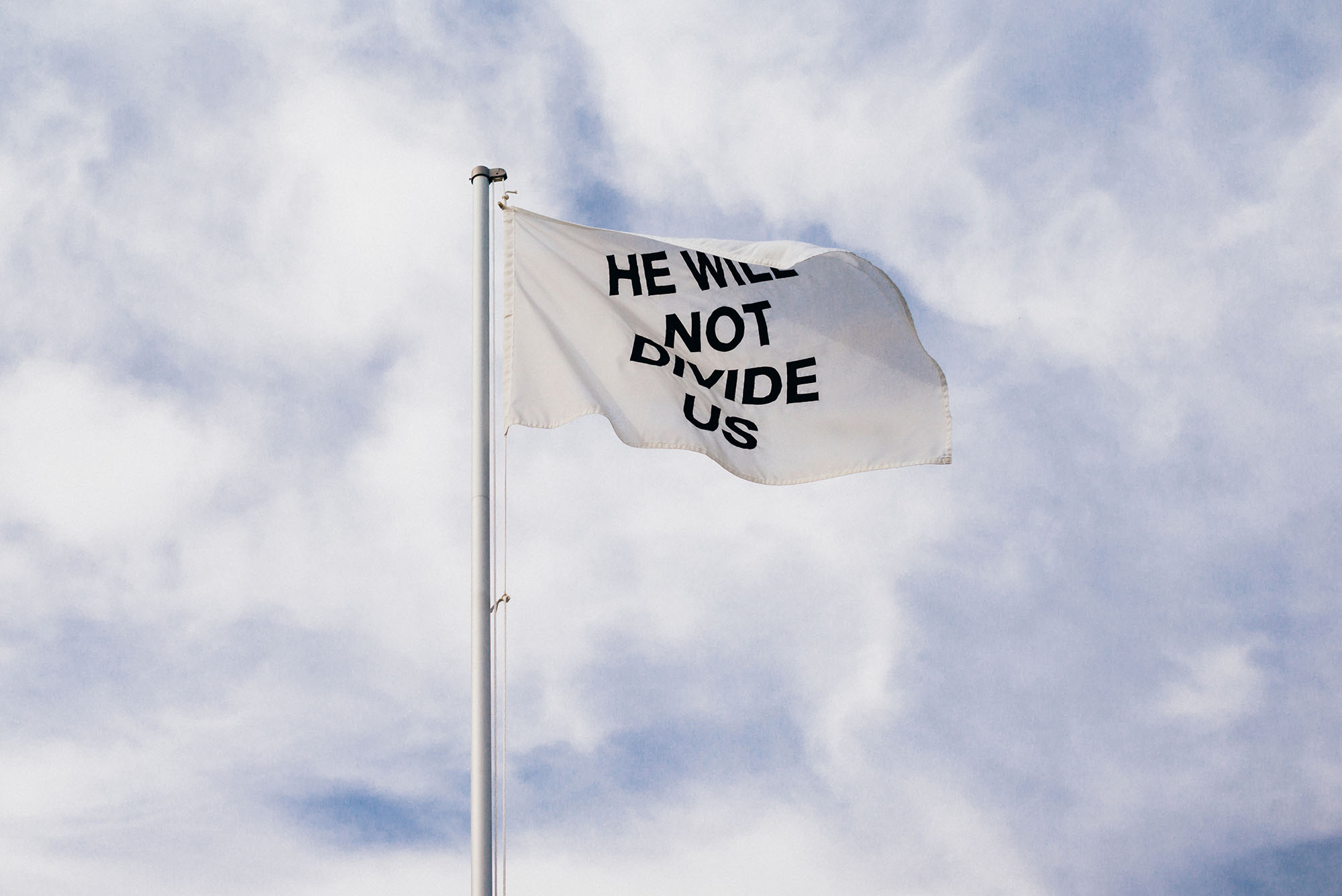
The camera had stopped showing a crowd. Now it showed a flag against the sky.
In March 2017, He Will Not Divide Us moved to an undisclosed location in Tennessee. The political artwork had already left two public venues. A flag could preserve the message while removing the gathering place. Instead, its location became another target. The official project archive records the flag’s theft on March 10. 1
The incident became a durable internet story: anonymous posters, an apparently featureless livestream, and an actor whose protest had become a game for hostile spectators. But the famous ending was only one episode. The artwork continued for years.
Before the flag, a wall in Queens
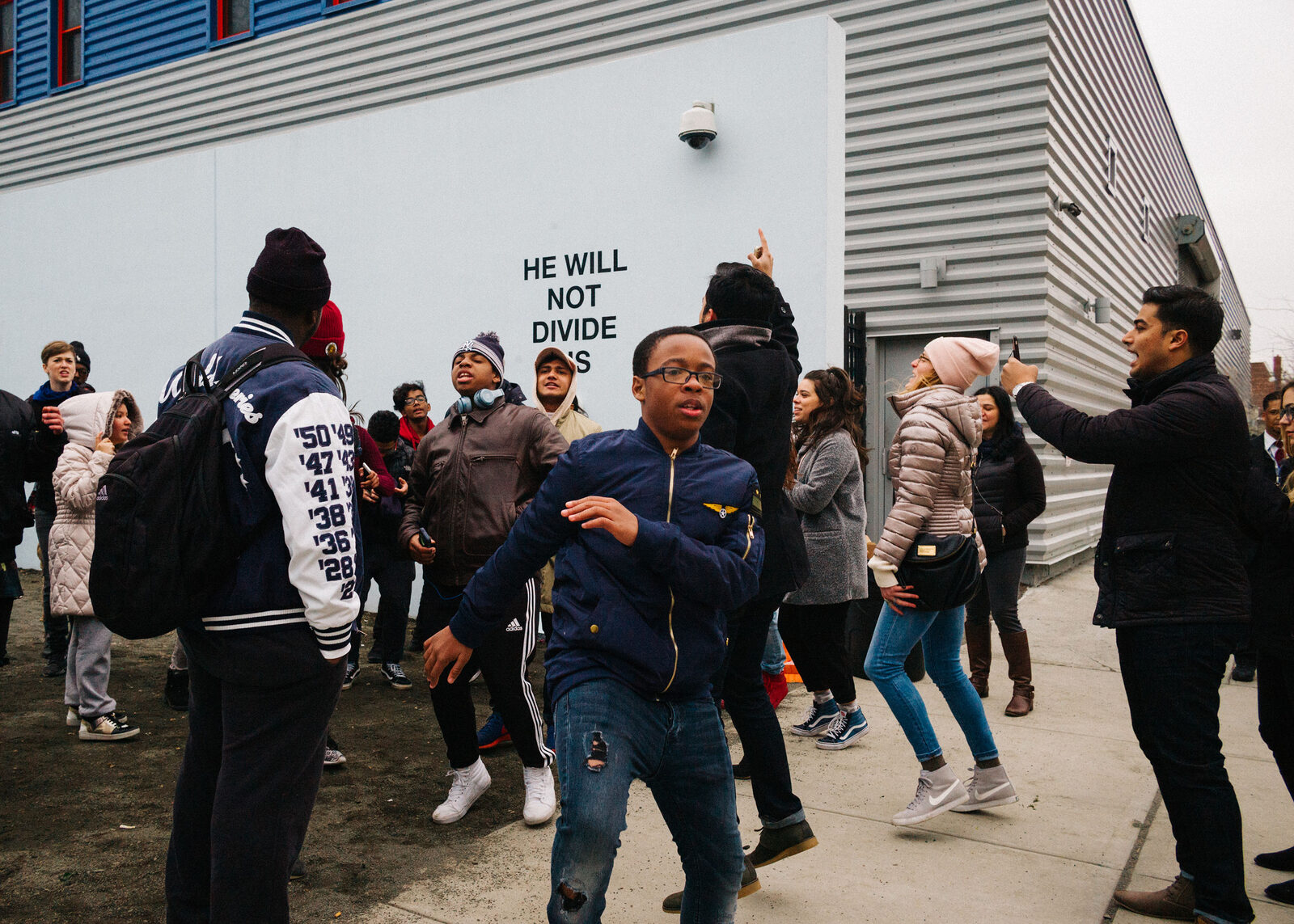
He Will Not Divide Us began outside New York’s Museum of the Moving Image on January 20, 2017. LaBeouf, Rönkkö & Turner invited members of the public to address a wall-mounted camera and repeat the project’s phrase. The stated plan was to livestream for the duration of the forty-fifth US presidency. 2
The mechanism was deliberately simple. A camera, a sentence, and public access allowed participants to supply the performance. That openness also meant the organizers could not decide in advance who would arrive or what a continuous broadcast would contain.
Calling it merely Shia LaBeouf’s flag erases both the original format and his collaborators. The object that became a meme was a later adaptation of a participatory artwork.
The first venue closed
On February 10, the museum ended its involvement. Its statement described threats, arrests, and an ongoing public safety problem. It said the project had departed from its original intention and that closure was necessary to protect visitors, staff, and neighbors. 2
This is a useful contemporaneous document because it explains a decision rather than celebrating a result. It records what the institution believed it could no longer manage.
Online retellings often turn each relocation into a score. The venue statement describes a different unit of measurement: the burden placed on the people responsible for the space around the camera. A stream can be watched from anywhere; its consequences still occur somewhere.
A quieter image became a challenge
After a further installation in Albuquerque, the project changed form. Contemporary reporting described its March 8 return at an unknown location, where viewers saw the flag rather than a public performance area. 4
For supporters, the image could carry continuity: the sentence remained visible despite disruption. For opponents, the concealed location supplied a task. The practical question of where the camera stood became entangled with the symbolic question of who controlled the broadcast.
Retellings attribute the discovery to combinations of observations from the stream and information found elsewhere online. Those claims should be checked against surviving records before any particular technique is presented as decisive. A successful discovery does not authenticate every later account of how it happened.
The frame left something out
The capture-the-flag framing is memorable because it supplies familiar rules: find the objective, reach it, replace the symbol, post the result. It also narrows the field of view until the artwork becomes an object waiting to be won.
A fuller account has to keep the political context. The project’s own archive identifies the Tennessee theft as an action by members of the neo-Nazi Traditionalist Worker Party. That is the artist’s account, and it should be attributed as such. 1
A board is not a single participant, and a collective boast is not an attendance list. Describing everything as something “4chan did” can conceal the distinction between people who watched, people who amplified, and people who entered the physical site.
Liverpool was another chapter
On March 22, FACT in Liverpool adopted the work. Its project page describes a flag streamed from the building’s roof and records the later removal of the installation on police advice because of dangerous, illegal trespassing. 3
Artnet’s contemporary coverage likewise documents disruption following the move to Liverpool. Read alongside the venue statement, it supports the broad sequence without requiring every triumphant claim circulating on message boards to be accepted. 5
The international relocation expanded the story’s geography. It did not transform trespass into an agreed competition. The difference matters because the language of play travels well online, while the responsibilities of a venue are considerably less entertaining to screenshot.
Timeline
- 2017-01-20 — New York The public camera performance begins.
- 2017-03-08 — Tennessee The project adopts a flag at an undisclosed location.
- 2017-03-10 — Theft The official archive records the stolen flag.
- 2017-03-22 — Liverpool FACT adopts the installation.
- 2021-01-20 — Conclusion The four-year artwork ends.
The project outlasted the meme
The official archive traces the later work through Nantes and an installation in Łódź, Poland, before the stream returned to Nantes. It records the project’s conclusion on January 20, 2021. It also says the stolen Tennessee flag was recovered by the FBI and returned in April 2021. 1
These later entries change the shape of the narrative. A story that ends with the flag disappearing suggests an artwork defeated into nonexistence. A chronology that continues into 2021 shows persistence, adaptation, and a physical object whose history continued after its most widely circulated image.
The archive is maintained from the artist’s perspective. That does not make it neutral, but it makes its position legible. Contemporary institutional statements and independent coverage help establish where accounts overlap and where they make different claims.
What the victory story preserves
The internet version preserves suspense particularly well. The visible sky seems to make the task impossible; the eventual discovery supplies release. The character of the actor, already a public figure, makes it easy to convert a complicated work into a personal confrontation.
What disappears in that edit is duration. A four-year artwork becomes a short contest. Collaborators become a celebrity. Institutions become backdrops. The participant standing near a camera and the anonymous viewer watching from another country are compressed into opposing teams.
A good historical account can retain the strange mechanics of the episode without adopting its scoreboard. It can describe the appeal of collective investigation, the spread of hostile attention, and the difference between an online joke and an action imposed on other people.
The surviving flag photographs are therefore more useful than a victory caption. They document different versions of the work, each shaped by what had happened to the previous one. Follow them far enough, and the familiar stolen-flag story becomes a longer account of an artwork struggling to remain visible.
Go to the source
Explore the original artwork’s photographic archive
What we know
- Established Venues published dated descriptions and closure notices.
- Attributed The project archive identifies the Tennessee perpetrators; this is the artist’s account.
- Needs care A board’s collective claims do not establish each participant’s role or the decisive discovery method.