 ChanTape
The save file was already there. Its name was BEN.
In the story that began circulating on 4chan’s paranormal board in September 2010, a student acquired a second-hand copy of The Legend of Zelda: Majora’s Mask. Someone else had played it before him. That would normally be an invitation to overwrite a stranger’s progress and get on with the game. Here, deleting the stranger became the problem. 3
BEN Drowned is fiction, created by Alex Hall under the name Jadusable. Knowing that does surprisingly little to weaken its opening. The unsettling object is familiar: a used game carrying traces of somebody you will never meet. The supernatural claim grows out of an ordinary feature of the hardware.
A help request with something attached
The initial account appeared on /x/, a board where paranormal stories, speculation, jokes, and skepticism shared the same scrolling space. A narrator asking for help could become an attraction before readers agreed whether to believe him. The first arc unfolded through posts and accompanying videos in September 2010. 6
A creepypasta is a horror story circulated online, often copied between communities. Hall added something more awkward to dismiss than a paragraph: footage apparently showing the game behaving incorrectly. The reader could leave the prose, open another platform, and inspect the alleged problem.
That movement between tabs was part of the storytelling. A video did not need to prove a haunting. It needed to give the audience a reason to keep examining the claim.
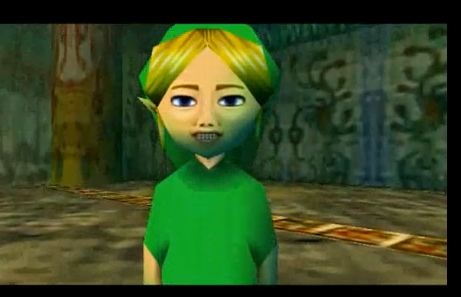
A world that had forgotten its player
The early narrative describes characters using the wrong name, then leaving the name blank after the BEN save is removed. Familiar game behavior becomes a record of an absent owner. The narrator’s attempt to clean up the cartridge makes the world less coherent. 4
This is a particularly economical kind of horror. The game has not become an unrelated nightmare setting. It remains recognizable enough that small departures matter. A line of dialogue becomes threatening because the audience knows what should occupy the gap.
There is also an uncomfortable social logic to a save file. It is someone’s unfinished activity, left inside an object now owned by someone else. The story turns that residue into a presence with objections.
The statue was already in the game
One of the story’s defining images is the Elegy of Emptiness statue, a motionless likeness of Link. In Hall’s fiction, its repeated appearances turn it into a pursuer. Empty locations, displaced sounds, and interrupted routines make the player’s environment feel hostile without replacing its visual vocabulary. 6
For an audience that recognizes Majora’s Mask, the effect depends on memory. You supply the normal version of the room or character, and the footage supplies a violation. Viewers unfamiliar with the game still encounter a figure that looks human enough to be wrong.
The statue’s stillness also changes the viewer’s job. Instead of watching a monster perform, you scan the frame, trying to determine whether something has moved since you last looked.
The footage had an author
In an interview with Arcade Attack, Hall discussed modifying a Nintendo 64 ROM with GameShark techniques and using video editing. Those comments provide a production explanation for the apparent evidence. They establish deliberate construction rather than an unexplained failure of a physical cartridge. 1
That does not make the videos irrelevant. It changes what they document. They are evidence of an author arranging game imagery into a narrative, and of an audience encountering those arrangements through the visual language of ordinary gameplay uploads.
A bad copy of the story loses this distinction. It retells the fictional student’s experiences as Alex Hall’s actual biography, then adds an admission of fakery as if it were a late investigative breakthrough. The creator and the character share a handle; they do not therefore share a life.
When the narrator stopped being dependable
The story eventually extends beyond the cartridge. Messages and documents make the reliability of Jadusable’s account part of the threat. A supposed roommate becomes another intermediary, while the material suggests that BEN can affect the channels through which the audience receives updates. 3
This is where the platform becomes more than a delivery service. If the threat can interfere with an upload or speak through an account, the reader loses an easy distinction between story and container. Even the surrounding information begins to require interpretation.
The audience is encouraged to act like an archive team: compare versions, preserve files, question timestamps, and decide which voice produced a message. The work of following the fiction becomes part of its atmosphere.
A cartridge became a larger world
The project moved into an alternate reality game, or ARG: a fiction distributed across media and websites that invites its audience to investigate. The archived timeline records the expansion beyond the initial posts into the broader Within Hubris material. 5
Hall returned to BEN Drowned in 2020. In a second Arcade Attack interview, he described a changed storytelling approach in which a protagonist’s activity was presented through video rather than primarily through retrospective diary entries. 2
Those different phases should not be compressed into a single haunted-cartridge anecdote. The early arc offers a tightly focused object horror story. The later work builds a larger fictional setting and asks its audience to navigate it. The same title covers a project that changed its scale.
Why the first file still works
The opening does not demand belief in ghosts. It asks whether you have ever opened a used device and found somebody else inside it: a name, an account, a forgotten photograph, a save that you hesitate to delete.
Hall’s distinctive move was to make the media surrounding that object appear vulnerable too. A forum post points to a video. A video points to another record. Each apparent explanation increases the number of things the audience must distrust.
Read today, BEN Drowned is most rewarding when its fiction is clearly identified and its original sequence is respected. Start with the posts and footage rather than a compilation of later fan images. Notice how little the first stages require, and how much uncertainty a familiar interface can carry.
The cartridge never needed to be haunted. It needed a previous owner, an unfinished game, and a narrator who could make deleting a name feel like opening a door.
Timeline
- 2010-09 — The Haunted Cartridge Posts and videos introduce Jadusable and BEN.
- 2010–2011 — Moon Children The project expands into an ARG.
- 2020 — Awakening Hall returns with a further story arc.
What we know
- Established Alex Hall created the story and discussed its production techniques.
- Fiction The haunted cartridge, BEN, and the narrator’s experiences belong to the narrative.
- Keep separate Later fan images and interpretations are not automatically original 2010 material.